The 12-12-12 Declutter Method: I Tried It for 7 Days — Here’s What Happened
Published: May 19, 2026 | By calm_builder | The Organized Calm
I almost didn’t write this.
Because admitting that yet another “viral decluttering method” actually worked feels… embarrassing. Like I’m confessing I didn’t know how to clean my own house until TikTok showed me.
But here’s the thing: I didn’t know.
I’m a busy woman with a full-time job, a mountain of laundry that regenerates overnight, and a junk drawer so chaotic I once found three unopened tubes of superglue and zero working pens inside it. I’ve read Marie Kondo. I’ve watched The Home Edit on Netflix. I’ve bought the pretty bins.
And my house? Still cluttered. Still stressful. Still the thing I apologized for whenever someone rang the doorbell.
Then I found the 12-12-12 method.
It’s gone viral on TikTok and Instagram over the past year, with thousands of people posting their daily transformations-22. The concept is brutally simple: every day, you find 12 items to keep and put back in their proper place, 12 items to throw away, and 12 items to donate or sell. 36 items. Every single day-22.
I decided to try it for seven straight days.
Here’s exactly what happened — the wins, the ugly moments, the things I learned about myself, and whether I’d actually recommend it to another overwhelmed woman.
What Is the 12-12-12 Decluttering Method?
Let me be clear: this isn’t some ancient Scandinavian philosophy. It wasn’t invented by a professional organizer with a book deal. The 12-12-12 challenge appears to have originated with the online minimalist community Becoming Minimalist, and it exploded on social media because it requires exactly zero skill, zero planning, and zero special equipment-22.
Here’s the framework:
| Category | What It Means | Examples |
|---|---|---|
| 12 Keep & Put Back | Items that belong in your home but aren’t where they should be | The sweater on the chair, the mail on the counter, the shoes by the door |
| 12 Throw Away / Recycle | Items that are trash, broken, expired, or genuinely useless | Expired coupons, dead batteries, dried-out pens, old receipts |
| 12 Donate or Sell | Items in decent condition that you no longer need or want | Clothes that don’t fit, duplicate kitchen tools, books you’ll never re-read |
36 items per day. That’s the magic number. It’s small enough to feel doable but large enough to create visible progress. You can do it in 20 minutes or stretch it across the whole day-22.
The genius of this method, as I discovered, isn’t really about the numbers. It’s about what the numbers force your brain to do.
Day 1: The Kitchen — “Wait, It’s Actually This Simple?”
I started in the kitchen because it’s where I feel the most daily friction. My counters collect mail like magnets. My junk drawer is legendary. I set a timer for 20 minutes and just… started.
12 items to keep and put back: Spatulas in the wrong drawer. A stack of mail that belonged in my office. Three coffee mugs that had migrated to the counter from the living room. A bag of rice that needed to go back in the pantry.
12 items to throw away: This was embarrassingly easy. Expired coupons from a restaurant that closed two years ago. A dried-out sponge. Three pens that didn’t work. A broken chip clip. Old grocery lists.
12 items to donate: I had four wooden spoons. Four! I kept my favorite two and put the others in the donate box. I also found a garlic press I haven’t used since 2019, a novelty mug from an ex-coworker, and a cookbook I’ve never opened.
Day 1 insight: The hardest part wasn’t finding items. It was stopping. Once I hit 36, I wanted to keep going. I made myself stop. That’s part of the method — it’s designed to prevent burnout by giving you a clear finish line.
Day 2: The Bedroom — The Emotional Side Appears
The kitchen was easy because there’s not much emotional weight attached to spatulas and chip clips. The bedroom? Different story.
I opened my closet and immediately felt that familiar paralysis. Clothes I spent good money on but never wear. A dress I wore to a wedding where someone broke my heart. Shoes that pinch but were expensive. A sweater my mom gave me that I’ve never liked.
The 12-12-12 method doesn’t tell you how to handle emotional items. That’s its one blind spot. But here’s what I discovered: having a quota actually made emotional decisions easier. I needed 12 donations. When you need to fill a number, you stop overthinking and start acting.
12 donations from my bedroom: The heartbreak dress. The sweater from mom (someone else will love it). Shoes that hurt. A handbag I bought to impress people I no longer know. Three stretched-out bras. Two pairs of jeans that haven’t fit in four years. A belt with a broken buckle I kept “just in case.”
12 items trashed: Expired makeup. A single earring with no mate. Old magazines. A candle burned down to nothing. Random receipts. A broken hanger.
Day 2 insight: The quota doesn’t just motivate you. It gives you permission. “I need 12 donations” removed the guilt from every single choice. It wasn’t “I’m rejecting this item.” It was “I’m completing the challenge.”
Day 3: The Bathroom — The Easy Win
I needed a win after the emotional bedroom session. The bathroom delivered.
Did you know you probably have six half-empty bottles of lotion? I did. I consolidated, trashed the empties, donated the unopened ones I’d never use. Old prescriptions went to the pharmacy disposal box. Expired sunscreen — gone. That weird bath bomb from three Christmases ago? Trash.
Total time: 12 minutes. The bathroom is small, contained, and mostly unemotional. If you’re struggling to start, begin here.
Day 4: The Dreaded Home Office / “Everything Drawer”
Every home has one: the space where things go to be forgotten. For me, it’s a rolling cart next to my desk. Drawers full of old chargers, mystery cables, sticky notes from 2024, business cards from people I’ve never contacted.
I opened the top drawer and felt my chest tighten.
But here’s what 12-12-12 does that “declutter the whole room” doesn’t: it shrinks the mountain into a molehill. I didn’t need to organize the entire office. I just needed 36 items. That’s a single drawer. Maybe two.
12 items trashed: Dead batteries. Mystery cables for devices I no longer own. A dried-out highlighter. Sticky notes with passwords from old jobs. Business cards from three positions ago.
12 items donated: A label maker I never use. Blank notebooks (I had seven — kept two). A stapler (I already had a better one). Extra scissors. A pencil cup.
Day 4 insight: Office clutter is mostly aspirational clutter — things you bought because you wanted to be the kind of person who uses a label maker, or keeps a bullet journal, or color-codes their files. Letting go of aspirational clutter means admitting you’re not that person. And that’s okay. That’s actually freeing.
Day 5: The Living Room — The “But It Looks Fine” Trap
The living room was tricky because it didn’t look cluttered. But looks deceive.
I opened the TV stand cabinet. Inside: old video games, tangled HDMI cables, a remote for a DVD player we no longer own, and a stack of manuals for appliances I could troubleshoot with Google.
The coffee table drawer revealed a similar story: coasters we never use, a deck of cards missing the seven of hearts, and — inexplicably — three pairs of reading glasses, none of which were my prescription.
Day 5 insight: Clutter hides in the places guests never open. The method forces you to look inside those spaces. It’s uncomfortable. It’s also transformative.
Day 6: The Sentimental Items — The Hardest Day
I’d been avoiding my hope chest. It sits at the foot of my bed, full of things I never look at but can’t seem to release: letters from old friends, my grandmother’s handkerchief, a necklace from a relationship that ended years ago.
The 12-12-12 method doesn’t require you to declutter sentimental items. But by Day 6, I felt ready to at least touch them.
I didn’t count these toward my 36. Instead, I gave myself a different rule: I could keep anything that made me genuinely smile. Everything else, I had to at least consider releasing.
I kept the handkerchief. I kept three letters that made me cry (in a good way). I let go of the necklace. I let go of a stack of greeting cards I’d never read again. I let go of a journal from a difficult period I don’t need to revisit.
Day 6 insight: Sentimental decluttering isn’t about getting rid of memories. It’s about curating them. I still have my grandmother’s handkerchief. I don’t have the guilt of the necklace. Both things can be true.
Day 7: The Whole-House Sweep — What I Learned
On the final day, I didn’t focus on one room. I walked through the entire house with fresh eyes, looking for the final 36 items.
And that’s when I realized: I could see my home differently now.
After six days of the 12-12-12 method, I’d trained my brain to notice what belongs and what doesn’t. The pile of mail on the dining table wasn’t just “mail” anymore — it was three keep items and nine trash items waiting to be dealt with. The cluttered nightstand wasn’t overwhelming — it was just 12 things that needed to find their home.
In seven days, I’d removed 252 items from my home. 84 thrown away. 84 donated. 84 put back where they actually belong.
What Surprised Me Most
1. The method works because it’s stupidly simple. There’s no color-coding system. No expensive bins. No complicated framework to memorize. 12 keep. 12 trash. 12 donate. You can do it half-asleep.
2. The quota removes guilt. When you need 12 donations, you stop asking “does this spark joy?” and start asking “do I actually use this?” One of those questions is subjective and paralyzing. The other is factual and freeing.
3. Decision fatigue is real, and this method fights it. Research from multiple Reddit threads confirms what I experienced: when everything becomes a choice, your brain shuts down-42. The 12-12-12 method limits your decisions to 36 per day. That’s manageable.
4. You’ll want to keep going. By Day 3, I was finding 36 items in 15 minutes. The method builds momentum because you see progress immediately.
What the 12-12-12 Method Doesn’t Solve
This method won’t fix deep emotional attachment to items. It won’t automatically organize what you keep. And it won’t stop new clutter from entering your home — you’ll need systems for that (I recommend the “one in, one out” rule).
But what it will do is break the paralysis. If you’ve been staring at your cluttered home for months, unable to start, this is your entry point.
Should You Try It?
Yes, if:
- You’re overwhelmed and don’t know where to begin
- You need a clear, daily win to stay motivated
- You want visible progress within 20 minutes
- You struggle with decision fatigue during decluttering
Maybe not, if:
- You’re dealing with deep sentimental grief (start with a therapist or a trusted friend)
- You prefer to declutter by category rather than by room
- You’re already a minimalist with very few items
Your 7-Day 12-12-12 Challenge (Start Today)
| Day | Focus Zone | Estimated Time |
|---|---|---|
| Day 1 | Kitchen counters + junk drawer | 20 min |
| Day 2 | Bedroom closet + dresser top | 25 min |
| Day 3 | Bathroom(s) | 15 min |
| Day 4 | Home office or “everything drawer” | 20 min |
| Day 5 | Living room (open cabinets, drawers) | 20 min |
| Day 6 | Sentimental items (go gentle) | As long as you need |
| Day 7 | Whole-house sweep — catch what you missed | 20 min |
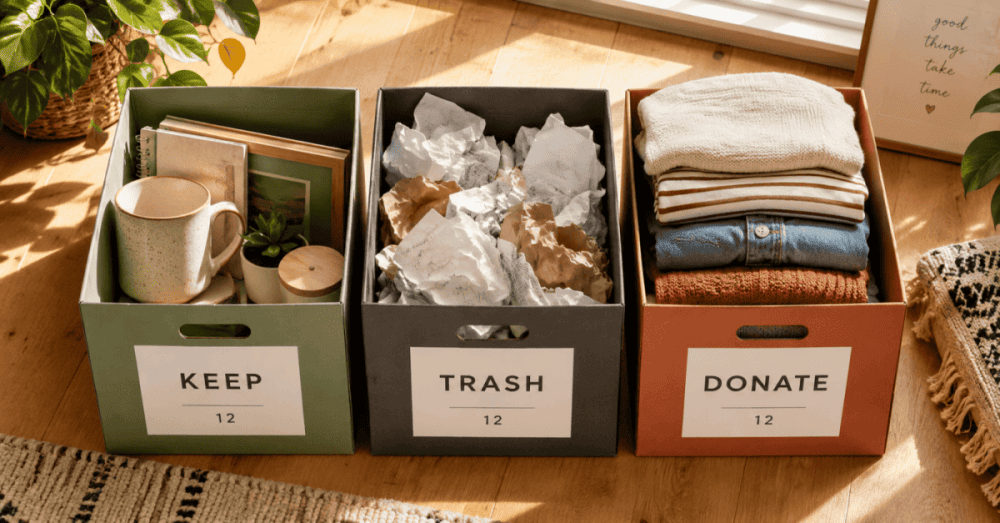
What you need: Three boxes or bags. Label them KEEP, TRASH, DONATE. That’s it.
Frequently Asked Questions
Q: What counts as “one item”?
A: Anything. A single pen. A piece of mail. A sock. Expired food counts. Don’t overthink the unit — the point is movement, not precision.
Q: What if I can’t find 12 items to donate?
A: You will. But if you genuinely can’t, increase your “keep and put back” or “trash” counts. The 36-item total is the goal.
Q: Can I do this if I have young children?
A: Yes. Do it during nap time, after bedtime, or involve them as a game. Many parents use 12-12-12 as a teaching tool.
Q: What if I miss a day?
A: Don’t restart. Don’t punish yourself. Just pick up where you left off. Progress, not perfection.
Q: Should I take before-and-after photos?
A: YES. You won’t believe the difference until you compare. And sharing your progress is what made this method go viral in the first place.
The Bottom Line
I’ve tried the KonMari method. I’ve tried the “clean all day Saturday” approach. I’ve tried buying organizational systems and hoping for the best.
The 12-12-12 method is the first one that made decluttering feel like something I could actually do — not something I was failing at.
If you’re an overwhelmed woman who feels like her home is constantly working against her, start here. Start today. You don’t need a whole weekend. You just need 20 minutes, three boxes, and permission to let go of 36 things.
Want a free, printable 7-day 12-12-12 tracking sheet? Pop your email below and I’ll send it straight to your inbox — plus weekly decluttering tips designed for busy women. No guilt. No perfection. Just progress.
“the exact bins I used” https://theorganizedcalm.com/the-18-drawer-organizer-set/
This post may contain affiliate links. If you purchase through these links, I may earn a commission at no additional cost to you. I only recommend products I’ve personally used and genuinely believe in.