Junk Drawer Organization That Actually Stays Organized
Every home has one — the drawer that started as “spare keys and a pen” and quietly became the place where anything without an obvious home goes to live. The problem isn’t that you have a junk drawer. It’s that nothing inside it has a defined spot, so it never gets smaller, only fuller.
Empty It Completely Before Organizing Anything
You can’t sort what you can’t see. Dump the whole drawer onto a table or tray first — this is also the fastest way to find the three dead batteries and two takeout menus for restaurants that closed last year.
Sort Into Real Categories, Not “Miscellaneous”
Most junk drawers actually hold five or six repeat categories: tools (small screwdriver, tape measure), adhesives (tape, glue), power (batteries, spare chargers), paper (menus, coupons, notepads), and loose hardware (spare screws, keys). Naming the categories is what makes the next step possible.
Use Dividers Sized to What You Actually Have
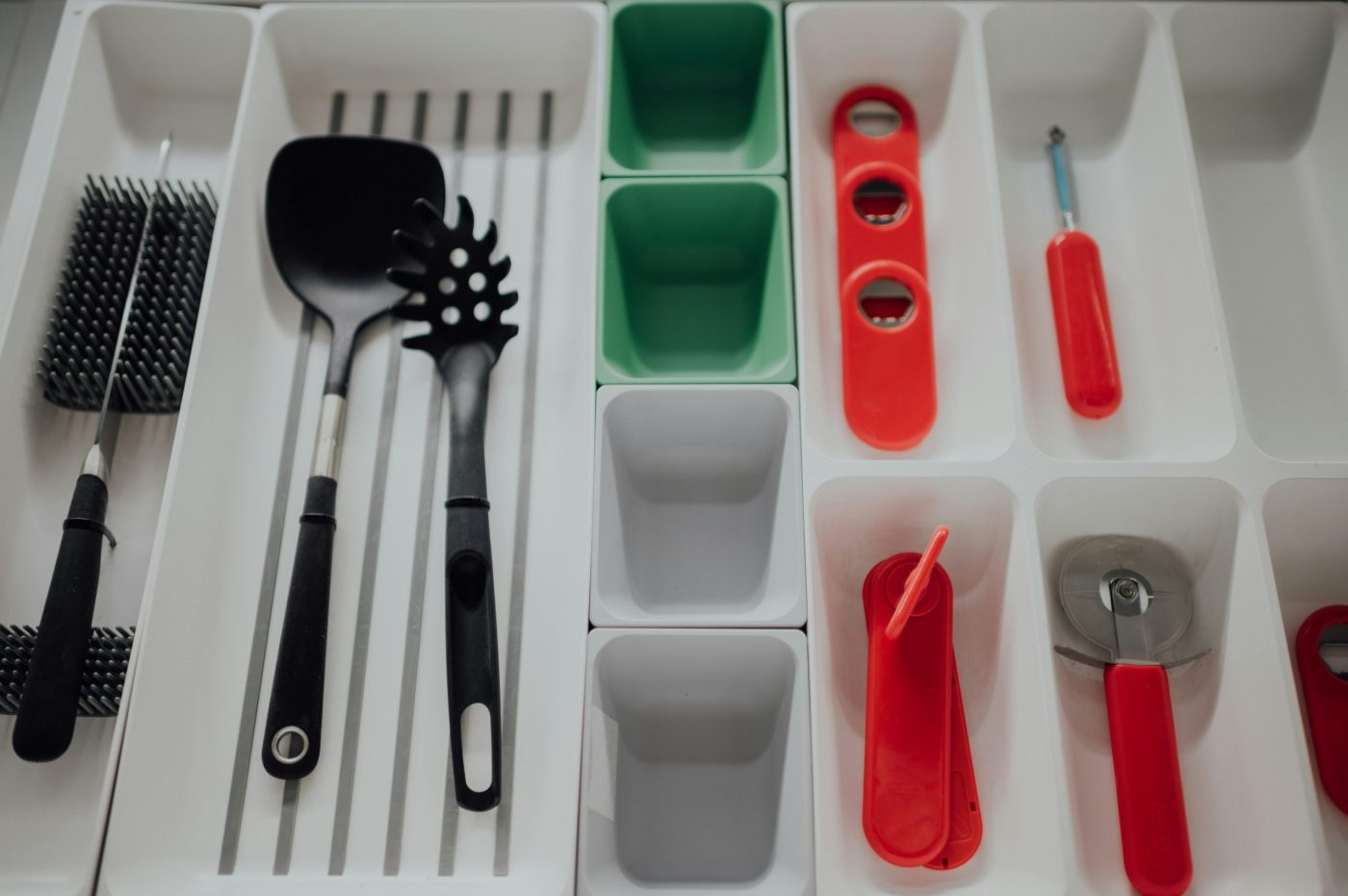
An adjustable drawer organizer — the kind with movable dividers rather than fixed slots — lets you build compartments that match your real mix instead of forcing your stuff into someone else’s idea of a junk drawer. Small items (batteries, rubber bands) need small compartments; bulkier items (tape, notepads) need one larger one.
Adjustable Drawer Divider Organizer
Expandable, interlocking dividers let you build a custom grid rather than being stuck with a fixed-size tray. Look for one with a non-slip base so the whole thing doesn’t shift every time you open the drawer.
Not for you if: your drawer is unusually shallow — measure depth first, since some divider systems need at least 2 inches of clearance to sit flat.
[Links to a live Amazon search for this category, tagged catuniverse02-20. Swap in the exact ASIN link once you’ve picked the specific product.]
Give Small Loose Items Their Own Trays
Batteries, rubber bands, twist ties, and loose screws are the items most likely to end up as a pile at the back of the drawer. A small stackable tray insert keeps these visually contained even inside a bigger divider system.
Small Stackable Tray Inserts
Look for a set with a few different compartment sizes rather than one uniform grid — batteries and rubber bands need different-sized slots. Clear trays make it easy to spot what’s inside without digging.
Not for you if: you only have a handful of small items — a single divider section (above) may already be enough without adding another layer.
[Links to a live Amazon search for this category, tagged catuniverse02-20. Swap in the exact ASIN link once you’ve picked the specific product.]
Set a Real Boundary on Paper
Takeout menus and coupons are the fastest-growing category in most junk drawers, mostly because nothing ever gets removed. A small file or slim paper tray with a hard limit (it’s full, so one comes out before one goes in) keeps this category from taking over the whole drawer.
Slim Paper/Mail Organizer Tray
A slim, low-profile tray keeps papers upright and visible instead of sliding into a flat pile. Pick one just deep enough for a small stack — oversized paper trays tend to get filled well past the point of being useful.
Not for you if: you already handle mail and paper clutter elsewhere in the house — this drawer doesn’t need to duplicate that system.
[Links to a live Amazon search for this category, tagged catuniverse02-20. Swap in the exact ASIN link once you’ve picked the specific product.]
Build In a 2-Minute Monthly Reset
Even a well-divided drawer drifts over a few months — a takeout menu here, a random cord there. A 2-minute check once a month (toss dead batteries, pull expired coupons, relocate anything that’s found a better home elsewhere) is what keeps the system working instead of slowly reverting to a pile.
Common Mistakes
- Buying one big bin instead of dividers. A single open bin just becomes a smaller version of the same pile — the fix is compartments, not containment.
- Sorting without measuring the drawer first. A divider system that’s too tall won’t let the drawer close; measure depth before ordering anything.
- Never revisiting it. Even a perfectly organized drawer needs the monthly 2-minute check, or it quietly refills exactly the way it did before.
- Keeping “maybe useful someday” items with no real category. If it doesn’t fit one of your named categories, it likely doesn’t belong in this drawer at all.
FAQ
What if I have more than one junk drawer?
Pick one as the “real” junk drawer with defined categories, and consolidate anything from a second one into it. Two junk drawers usually means the categories weren’t clear the first time, not that you genuinely need double the space.
Where do dead batteries actually go?
Most municipalities have battery recycling drop-off points at hardware or home improvement stores — they shouldn’t go in regular trash. Keeping a small designated spot in the drawer for “batteries to recycle” (separate from fresh ones) makes this an easy stop on your next errand run.
How often should I redo this drawer completely?
If you’re doing the 2-minute monthly reset, a full redo shouldn’t be necessary more than once or twice a year — usually around a seasonal reset when habits or households change.